Faith endures as seeing Him who is invisible (Heb. 11:27); endures the disappointments, the hardships, and the heart-aches of life, by recognizing that all comes from the hand of Him who is too wise to err and too loving to be unkind. But so long as we are occupied with any other object than God Himself, there will be neither rest for the heart nor peace for the mind. But when we receive all that enters our lives as from His hand, then, no matter what may be our circumstances or surroundings—whether in a hovel or prison-dungeon, or at a martyr’s stake—we shall be enabled to say, ” The lines are fallen unto me in pleasant places” (Ps. 16:6). But that is the language of faith, not of sight nor of sense.
Whenever you come in contact with the great destructive sins in other lives, be reverent with what you don’t understand. There are facts in each life you know nothing about and God says: “Leave him to Me.”
“If you allow anything to hide the face of Jesus Christ from you, you are either disturbed or you have a false security. “My peace I give unto you” is a peace which comes from looking into His face and realising His undisturbedness.”
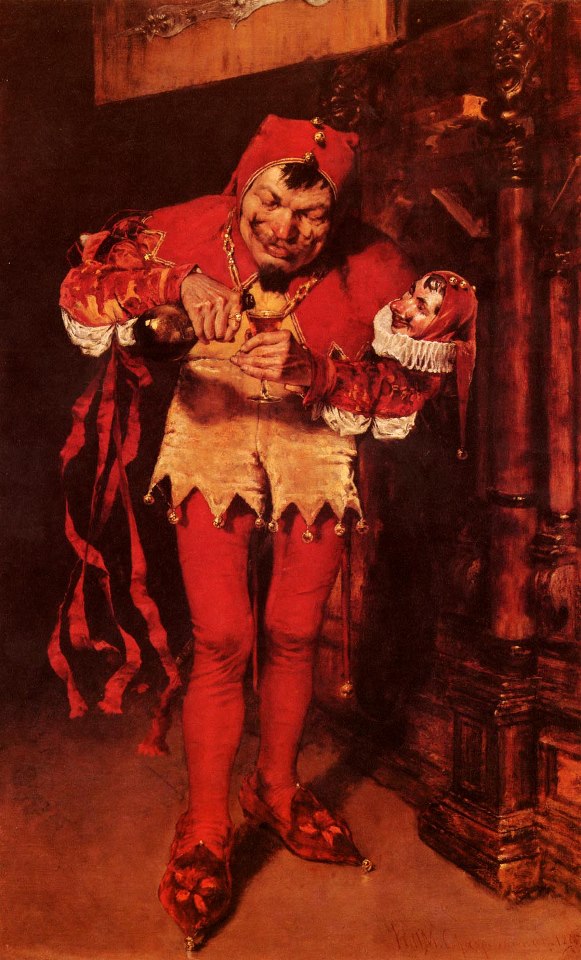
Foolish talking and jesting are not the ways in which Christian cheerfulness should express itself, but rather “giving of thanks” (Eph. 5:4). Religion is the source of joy and gladness, but its joy is expressed in a religious way, in thanksgiving and praise.
“No wise man can expect that…God should diet us with a continual feast. It would neither suit with our health, nor the condition of this pilgrimage. Live, therefore, on your peace of conscience as your ordinary diet; when this is wanting, know that God appointeth you a fast for your health; and when you have a feast of high joys, feed on it and be thankful! But when they are taken from you, gape not after them as the disciples did after Christ at His ascension; but return thankfully to your ordinary diet of peace.”
Psalm 16:11 You will show me the path of life;
In Your presence is fullness of joy;
At Your right hand are pleasures forevermore.
Thomas Watson – (ca. 1620-1686), English non-conformist Puritan preacher and author
Watson was educated at Emmanuel College, Cambridge, where he was noted for remarkably intense study. In 1646 he commenced a sixteen year pastorate at St. Stephen’s, Walbrook. He showed strong Presbyterian views during the civil war, with, however, an attachment to the king, and in 1651 he was imprisoned briefly with some other ministers for his share in Christopher Love’s plot to recall Charles II of England. He was released on June 30, 1652, and was formally reinstated as vicar of St. Stephen’s Walbrook.
Watson obtained great fame and popularity as a preacher until the Restoration, when he was ejected for nonconformity. Notwithstanding the rigor of the acts against dissenters, Watson continued to exercise his ministry privately as he found opportunity. Upon the Declaration of Indulgence in 1672 he obtained a license to preach at the great hall in Crosby House. After preaching there for several years, his health gave way, and he retired to Barnston, Essex, where he died suddenly while praying in secret. He was buried on 28 July 1686.
“Take up your own daily cross, it is the burden most suited for your shoulder and will prove most effective to make you perfect in every good word and work to the glory of God.”
“The Bible applied to the heart by the Holy Ghost, is the chief means by which men are built up and established in the faith, after their conversion. It has done it for thousands already, and it is doing it for thousands every day.”
“In efficacious grace we are not merely passive, nor yet does God do some and we do the rest. But God does all, and we do all. God produces all, we act all. For that is what produces, viz. our own acts. God is the only proper author and fountain; we only are the proper actors. We are in different respects, wholly passive and wholly active.”