“The Holy Spirit is an illuminator He is a light to the inner heart. And He will show you more of God in a moment than you can ever learn in a lifetime without Him. Then, when He does come, all that you have learned and all that you do learn will have its proper place in your total personality and total creed and total thinking.”
“Even the tired horse, when he comes near home, mends pace: be good always, without weariness, but best at last; that the nearer thou comest to the end of thy days, the nearer thou mayest be to the end of thy hopes, the salvation of thy soul.”
1 The Lord is my shepherd, I lack nothing.
2 He makes me lie down in green pastures,
he leads me beside quiet waters,
3 he refreshes my soul.
Hebrews 13:5 Keep your lives free from the love of money and be content with what you have, because God has said,
“Never will I leave you;
never will I forsake you.”
Mary and Thomas Winslow went on to live in England and Octavius was born in Pentonville, then a village near London, on August 1, 1808. He was the tenth of 13 children. His name seems to have been given because he was then the eighth surviving child. Octavius’s father was from a wealthy family but by 1815, following his retirement from the army, he suffered ill-health and the loss of his fortune due to one of several such national financial disasters that occurred in this period. A decision was made to move to America, but before Mr Winslow could join his wife and children in New York, he died. At the same time, their youngest child died too.
Widowed at 40, responsible for a large family and scarcely settled in America, Mrs Winslow’s entire life was turned upside down. Worst of all, spiritual darkness and despondency overwhelmed her for some months. Octavius was seven years old. They were a deeply religious family and Octavius later wrote a book about their experiences from his mother’s perspective in a book entitled Life in Jesus, available on google books. All of the children became Christians, and three sons became evangelical ministers.
It is suggested that Winslow began his ministerial training in Stepney, London, but then moved to Columbia College, New York. He was certainly ordained as a pastor June 21,1833 (aged 25) in New York. He is said to have ministered in the newly started Second Baptist Church there in Brooklyn, in 1836 and 1837, the work sadly closing in 1838. In 1839 he moved back to England where he became one of the most valued ministers of the time. This was largely due to the earnestness of his preaching and the excellence of his prolific writings.
He was married to a Miss Ann Ring and they had four boys and four girls. His son, John Whitmore, died in 1856 aged only 21 and Octavius went on to publish some of the things he had written as a teenager.
“What is the reason there is so much preaching and so little practice? For want of meditation…. Constant thoughts are operative, and musing makes the fire burn. Green wood is not kindled by a flash or spark, but by constant blowing.”
When we find our souls at all declining, it is best to raise them up presently by some awakening meditations, such as of the presence of God, of the strict reckoning we are to make, of the infinite love of God in Christ and the fruits of it, of the excellency of a Christian’s calling, of the short and uncertain time of this life, of how little good all those things that steal away our hearts will do us before long, and of how it shall be for ever with us hereafter, as we spend this short time well or ill. The more we make way for such considerations to sink into our hearts, the more we shall rise nearer to that state of soul which we shall enjoy in heaven.
Words: William Whiting, 1860. He wrote the lyrics as a poem for a student about to sail for America.
Music: Melita, John B. Dykes, in Hymns Ancient and Modern, 1861. Dykes fittingly named the tune after a locale associated with a Biblical shipwreck. Melita was the
island the Apostle Paul reached after his ship went down (Acts 28:1); today we know it as the isle of Malta.
William Whiting (1825-1878)
In America, Eternal Father is often called the Navy Hymn, because it is sung at the Naval Academy in Annapolis, Maryland. It is also sung on ships of the British Royal Navy and has been translated into French. It was the favorite hymn of U.S. President Franklin Roosevelt and was sung at his funeral in Hyde Park, New York, April 1945. The Navy Band played it in 1963 as U.S. President John Kennedys body was carried up the steps of the U.S. Capitol to lie in state. Roosevelt served as Secretary of the Navy, and Kennedy was a PT boat commander in World War II.
The original words were written as a hymn by a schoolmaster and clergyman of the Church of England, the Rev. William Whiting. Rev. Whiting (1825-1878) resided on the English coast near the sea and had once survived a furious storm in the Mediterranean. His experiences inspired him to pen the ode, “Eternal Father, Strong to Save.” In the following year, 1861, the words were adapted to music by another English clergyman, the Rev. John B. Dykes (1823-1876) , who had originally written the music as “Melita” (ancient name for the Mediterranean island of Malta). Rev. Dykes’ name may be recognized as that of the composer given credit for the music to many other well-known hymns, including “Holy, Holy, Holy,” “Lead, Kindly Light,” “Jesus, Lover of My Soul,” and “Nearer, My God to Thee.”
In the United States, in 1879 the late Rear Adm. Charles Jackson Train, an 1865 graduate of the United States Naval Academy at Annapolis was a lieutenant commander stationed at the Academy in charge of the Midshipman Choir. In that year, Lt. Comdr. Train inaugurated the present practice of concluding each Sunday’s Divine Services at the Academy with the singing of the first verse of this hymn.
The hymn, entitled “Eternal Father, Strong to Save,” is found in most Protestant Hymnals. It can be more easily located in these hymnals by consulting the “Index to First Lines” under “Eternal Father, Strong to Save.” The words have been changed several times since the original hymn by Rev. Whiting was first published in 1860-61. One will find that the verses as now published differ from the original primarily in the choice of one or two words in several lines of each verse.
John Owen was by common consent the weightiest Puritan theologian, and many would bracket him with Jonathan Edwards as one of the greatest Reformed theologians of all time.
Hebrews 2:3 How shall we escape, if we neglect so great salvation; which at the first began to be spoken by the Lord, and was confirmed unto us by them that heard him;
Romans 10:10 For with the heart man believeth unto righteousness; and with the mouth confession is made unto salvation.
John Owen – (1616-1683), Congregational theologian
Born at Stadhampton, Oxfordshire, Owen was educated at Queen’s College, Oxford, where he studied classics and theology and was ordained. Because of the “high-church” innovations introduced by Archbishop William Laud, he left the university to be a chaplain to the family of a noble lord. His first parish was at Fordham in Essex, to which he went while the nation was involved in civil war. Here he became convinced that the Congregational way was the scriptural form of church government. In his next charge, the parish of Coggeshall. in Essex, he acted both as the pastor of a gathered church and as the minister of the parish. This was possible because the parliament, at war with the king, had removed bishops. In practice, this meant that the parishes could go their own way in worship and organization.
Oliver Cromwell liked Owen and took him as his chaplain on his expeditions both to Ireland and Scotland (1649-1651). Owen’s fame was at its height from 1651 to 1660 when he played a prominent part in the religious, political, and academic life of the nation. Appointed dean of Christ Church, Oxford, in 1651, he became also vice-chancellor of the university in 1652, a post he held for five years with great distinction and with a marked impartiality not often found in Puritan divines. This led him also to disagreement, even with Cromwell, over the latter’s assumption of the protectorship. Owen retained his deanery until 1659. Shortly after the Restoration of the monarchy in 1660, he moved to London, where he was active in preaching and writing until his death. He declined invitations to the ministry in Boston (1663) and the presidency of Harvard (1670) and chided New England Congregationalists for intolerance. He turned aside also from high preferment when his influence was acknowledged by governmental attempts to persuade him to relinquish Nonconformity in favor of the established church.
His numerous works include The Display of Arminianism (1642); Eshcol, or Rules of Direction for the Walking of the Saints in Fellowship (1648), an exposition of Congregational principles; Saius Electorum, Sanguis Jesu (1648), another anti-Arminian polemic; Diatriba de Divina Justitia (1658), an attack on Socinianism; Of the Divine Original Authority of the Scriptures (1659); Theologoumena Pantodapa (1661), a history from creation to Reformation; Animadversions to Fiat Lux (1662), replying to a Roman Catholic treatise; Doctrine of Justification by Faith (1677); and Exercitationes on the Epistle to the Hebrews (1668-1684).
Jesus Christ says, “Except ye . . . become as little children . . .” A little child is certain of its parents, but uncertain about everything else, therefore it lives a perfectly delightful healthy life.
My Utmost For His Highest, his best-known book, has been continuously in print in the United States since 1935 and remains in the top ten titles of the religious book bestseller list with millions of copies in print. It has become a Christian classic.
1 Peter 2:20 For what glory is it, if, when ye be buffeted for your faults, ye shall take it patiently? but if, when ye do well, and suffer for it, ye take it patiently, this is acceptable with God. 21 For even hereunto were ye called: because Christ also suffered for us, leaving us an example, that ye should follow his steps
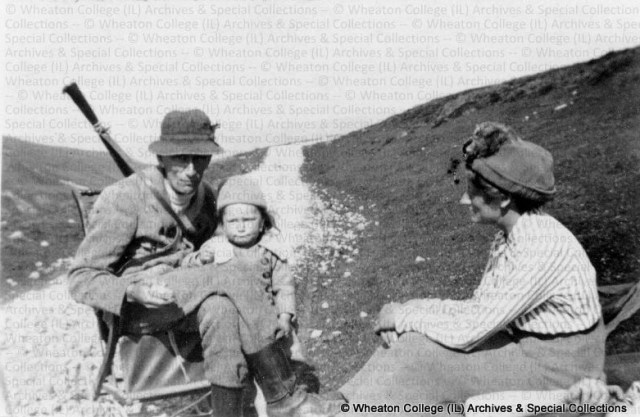
Oswald Chambers (1874-1917) was born July 24, 1874, in Aberdeen, Scotland. Converted in his teen years under the ministry of Charles Haddon Spurgeon, he studied art and archaeology at the University of Edinburgh before answering a call from God to the Christian ministry. He then studied theology at Dunoon College. From 1906-1910 he conducted an itinerant Bible-teaching ministry in the United States, the United Kingdom, and Japan.
In 1910, Chambers married Gertrude Hobbs. They had one daughter, Kathleen.
In 1911 he founded and became principal of the Bible Training College in Clapham, London, where he lectured until the school was closed in 1915 because of World War I. In October 1915 he sailed for Zeitoun, Egypt (near Cairo), where he ministered to troops from Australia and New Zealand as a YMCA chaplain. He died there November 15, 1917, following surgery for a ruptured appendix.
Although Oswald Chambers wrote only one book, Baffled to Fight Better, more than thirty titles bear his name. With this one exception, published works were compiled by Mrs. Chambers, a court stenographer, from her verbatim shorthand notes of his messages taken during their seven years of marriage. For half a century following her husband’s death she labored to give his words to the world.