
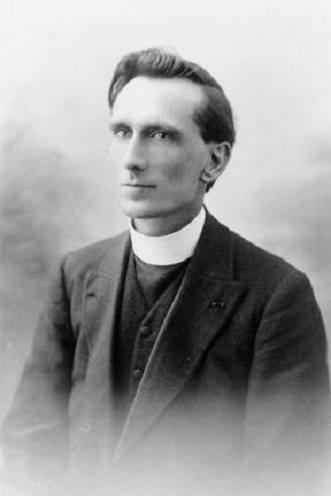
Never be deluded into making this statement: “I am here because I am so useful,” say rather “I am here because God wants me here.” The one lodestar of the saint is God Himself, not estimated usefulness.
– Chambers, Oswald: Run Today’s Race
Never be deluded into making this statement: “I am here because I am so useful,” say rather “I am here because God wants me here.” The one lodestar of the saint is God Himself, not estimated usefulness.
– Chambers, Oswald: Run Today’s Race

“I have now concentrated all my prayers into one, and that one prayer is this, that I may die to self, and live wholly to Him.”
– Charles Spurgeon

“Soon the battle will be over. It will not be long now before the day will come when Satan will no longer trouble us. There will be no more domination, temptation, accusation, or confrontation. Our warfare will be over and our commander, Jesus Christ, will call us away from the battlefield to receive the victor’s crown.”
– Thomas Watson (Puritan)

“Here is the fundamental difference between the man of faith and the man of unbelief. The unbeliever is “of the world” and judges everything by worldy standards, views life from the standpoint of time and sense, and weighs everything in the balances of his own carnal making. But the man of faith brings in God, looks at everything from His standpoint, estimates values by spiritual standards, and views life in the light of eternity. Doing this, he receives whatever comes as from the hand of God. Doing this, his heart is calm in the midst of the storm. Doing this, he rejoices in hope of the glory of God.”
– Arthur Pink, “The Sovereignty of God”

“Anxiety does not empty tomorrow of its sorrows, but only empties today of its strength.”
– Charles Spurgeon
J. R. Miller – Our Conception of Christlikeness (Christian devotional reading)
J.R. Miller playlist: http://www.youtube.com/view_play_list?p=2085C7193D4C2AAE
Link to my “Christian Devotional Readings” Facebook page: https://www.facebook.com/pages/Christian-Devotional-Readings/196846270398160?ref=hl
A Treasury of Ageless,
Sovereign Grace,
Devotional Writings http://www.gracegems.org/
2 Corinthians 4:10 We always carry around in our body the death of Jesus, so that the life of Jesus may also be revealed in our body.
1 Peter 2:21 To this you were called, because Christ suffered for you, leaving you an example, that you should follow in his steps.
James Russell Miller was born on March 20, 1840 at Frankfort Springs, Pennsylvania and died on July 2, 1912. Besides authoring over 80 books, booklets, and pamphlets, he was the Editorial Superintendent of the Presbyterian Board of Publication and a very active pastor in a succession of churches.
The crucible of his education was his service with the United States Christian Commission, an agency set up to minister to the troops, during the civil war. When the war ended he completed his theological studies and was ordained and installed on September 11, 1867. On June 22, 1870, when he was thirty, he married Miss Louise E. King.
The end of life on earth came without warning on the afternoon of July 2, 1912. JR’s wife, Louise Miller, and their only daughter, Mary Wanamaker Miller (Mrs. W.B. Mount), were present, but it was impossible to summon the sons — William King Miller and Russell King Miller. One moment he seemed to be resting quietly; the next he was at rest.
He was one of the best selling Christian authors of his era. His books had a total circulation of over two million copies during his lifetime and in 1911 the Presbyterian Board of Publication, under his direction, published over 66 million copies of its periodicals.
“What does love look like? It has the hands to help others. It has the feet to hasten to the poor and needy. It has eyes to see misery and want. It has the ears to hear the sighs and sorrows of men. That is what love looks like.”
“He loves Thee too little who loves anything together with Thee, which he loves not for Thy sake.”
– Augustine of Hippo

“Uncertainty as to our relationship with God is one of the most enfeebling and dispiriting of things. It makes a man heartless. It takes the pith out of him. He cannot fight; he cannot run. He is easily dismayed and gives way. He can do nothing for God. But when we know that we are of God, we are vigorous, brave, invincible. There is no more quickening truth than this of assurance.”
– Horatius Bonar
Thomas Watson – Sanctification
“For this is the will of God, even your sanctification.” 1 Thessalonians 4:3
Thomas Watson playlist: http://www.youtube.com/playlist?list=PL9B58A93B5F60F495
Link to my “Christian Devotional Readings” Facebook page: https://www.facebook.com/ChristianDevotionalReadings
Thomas Watson – (ca. 1620-1686), English non-conformist Puritan preacher and author
Watson was educated at Emmanuel College, Cambridge, where he was noted for remarkably intense study. In 1646 he commenced a sixteen year pastorate at St. Stephen’s, Walbrook. He showed strong Presbyterian views during the civil war, with, however, an attachment to the king, and in 1651 he was imprisoned briefly with some other ministers for his share in Christopher Love’s plot to recall Charles II of England. He was released on June 30, 1652, and was formally reinstated as vicar of St. Stephen’s Walbrook.
Watson obtained great fame and popularity as a preacher until the Restoration, when he was ejected for nonconformity. Notwithstanding the rigor of the acts against dissenters, Watson continued to exercise his ministry privately as he found opportunity. Upon the Declaration of Indulgence in 1672 he obtained a license to preach at the great hall in Crosby House. After preaching there for several years, his health gave way, and he retired to Barnston, Essex, where he died suddenly while praying in secret. He was buried on 28 July 1686.
Octavius Winslow – Christ’s Sympathy to Weary Pilgrims (Christian audio book reading)
“Cast your burden upon the Lord, and he shall sustain you.” Psalm 55:22
“Be of good cheer: it is I; be not afraid.” Mark 6:50
“My times are in your hand.” Psalm 31:15
“For this God is our God for ever and ever: he will be our guide even unto death.” Psalm 48:14
“Jesus wept.” John 11:35
“Casting all your care upon him; for he cares for you.” 1 Peter 5:7
“And we know that all things work together for good to those who love God, to those who are the called according to his purpose.” Romans 8:28
“But even the very hairs of your head are all numbered.” Luke 12:7
Octavius Winslow playlist: http://www.youtube.com/view_play_list?p=0434F5E3E1C7DED8
Link to my “Christian Devotional Readings” Facebook page: https://www.facebook.com/pages/Christian-Devotional-Readings/196846270398160?ref=hl
A Treasury of Ageless,
Sovereign Grace,
Devotional Writings http://www.gracegems.org/
Mary and Thomas Winslow went on to live in England and Octavius was born in Pentonville, then a village near London, on August 1, 1808. He was the tenth of 13 children. His name seems to have been given because he was then the eighth surviving child. Octavius’s father was from a wealthy family but by 1815, following his retirement from the army, he suffered ill-health and the loss of his fortune due to one of several such national financial disasters that occurred in this period. A decision was made to move to America, but before Mr Winslow could join his wife and children in New York, he died. At the same time, their youngest child died too.
Widowed at 40, responsible for a large family and scarcely settled in America, Mrs Winslow’s entire life was turned upside down. Worst of all, spiritual darkness and despondency overwhelmed her for some months. Octavius was seven years old. They were a deeply religious family and Octavius later wrote a book about their experiences from his mother’s perspective in a book entitled Life in Jesus, available on google books. All of the children became Christians, and three sons became evangelical ministers.
It is suggested that Winslow began his ministerial training in Stepney, London, but then moved to Columbia College, New York. He was certainly ordained as a pastor June 21,1833 (aged 25) in New York. He is said to have ministered in the newly started Second Baptist Church there in Brooklyn, in 1836 and 1837, the work sadly closing in 1838. In 1839 he moved back to England where he became one of the most valued ministers of the time. This was largely due to the earnestness of his preaching and the excellence of his prolific writings.
He was married to a Miss Ann Ring and they had four boys and four girls. His son, John Whitmore, died in 1856 aged only 21 and Octavius went on to publish some of the things he had written as a teenager.


