“If you neglect to instruct (your children) in the way of holiness, will the devil neglect to instruct them in the way of wickedness? No; if you will not teach them to pray, he will to curse, swear, and lie; if ground be uncultivated, weeds will spring.”
“If a man will resign himself in implicit trust to the Lord Jesus, he will find that He leads the wayfaring soul into the green pastures and beside the still waters, so that even when he goes through the dark valley of the shadow of some staggering episode, he will fear no evil. Nothing in life or death, time or eternity, can stagger a soul from the certainty of the Way, for one moment.”
“The more perfect the sight is the more delightful the beautiful object. The more perfect the appetite, the sweeter the food. The more musical the ear, the more pleasant the melody. The more perfect the soul, the more joyous the joys of heaven and the more glorious that glory.”
“Thousands of people are happy without God in this world, but that kind of happiness and peace is on a wrong level. Jesus Christ came to send a sword through every peace that is not based on a personal relationship to Himself.”
“There is no doctrine in Christianity so important as the doctrine of Christ crucified. There is none which the devil tries so hard to destroy. There is none which it is so needful for our own peace to understand.”
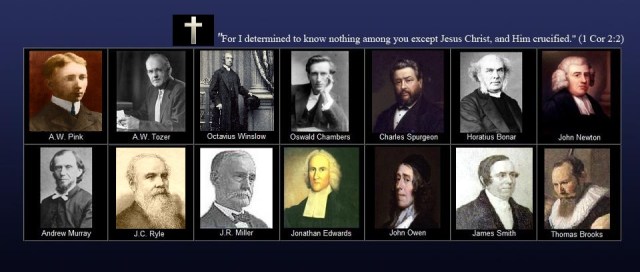
J.C. Ryle – (1816-1900), first Anglican bishop of Liverpool
John Charles Ryle was born at Macclesfield and was educated at Eton and at Christ Church, Oxford. He was a fine athlete who rowed and played Cricket for Oxford, where he took a first class degree in Greats and was offered a college fellowship (teaching position) which he declined. The son of a wealthy banker, he was destined for a career in politics before answering a call to ordained ministry.
He was spiritually awakened in 1838 while hearing Ephesians 2 read in church. He was ordained by Bishop Sumner at Winchester in 1842. After holding a curacy at Exbury in Hampshire, he became rector of St Thomas’s, Winchester (1843), rector of Helmingham, Suffolk (1844), vicar of Stradbroke (1861), honorary canon of Norwich (1872), and dean of Salisbury (1880). In 1880, at age 64, he became the first bishop of Liverpool, at the recommendation of Prime Minister Benjamin Disraeli. He retired in 1900 at age 83 and died later the same year.
Ryle was a strong supporter of the evangelical school and a critic of Ritualism. Among his longer works are Christian Leaders of the Eighteenth Century (1869), Expository Thoughts on the Gospels (7 vols, 1856-69) and Principles for Churchmen (1884).
“I say the spiritual life in Christians ought to be more evident. Our lamps need trimming—they ought not to burn so dim. Our separation from the world should be more distinct—our walk with God more decided. Too many of us are like Lot—lingerers; or like Reuben, Gad, and Manasseh—borderers; or like the Jews in Ezra’s time—so mixed up with strangers, that our spiritual pedigree cannot be made out.”
Christian Praise and Worship in Songs, Sermons, and Audio Books (my YouTube channel)
A large video collection (over 3,400 videos as of July 26, 2013) of classic hymns, Praise and Worship songs, and the works (audio books, devotional readings, and sermons) of men greatly used of God, such as: Charles Spurgeon, Jonathan Edwards, A.W. Tozer, A.W. Pink, John Owen, Oswald Chambers, Andrew Murray, John MacArthur, E.M. Bounds, John Bunyan, George Whitefield, and many more, covering topics on many aspects of the Christian life. May your time spent here be blessed. http://www.youtube.com/user/stack45ny
My new original song, “Behold, I am Coming Quickly! / Revelation 3.” If you have a YouTube account, and find the song a blessing, please consider clicking “Like,” for doing so will help my video rank higher in search engines and therefore reach more people. Saving the video to your favorites and playlists is also helpful…thank you. http://www.youtube.com/watch?v=ujrx1OnPcL0&feature=share&list=PL2ACD992264D713AC
Aiden Wilson Tozer was born April 21, 1897, on a small farm among the spiny ridges of Western Pennsylvania.
Tozer’s forte was his prayer life which often found him walking the aisles of a sanctuary or lying face down on the floor. He noted, “As a man prays, so is he.” To him the worship of God was paramount in his life and ministry. “His preaching as well as his writings were but extensions of his prayer life,” comments Tozer biographer James L. Snyder. An earlier biographer noted, “He spent more time on his knees than at his desk.”
Tozer’s love for words also pervaded his family life. He quizzed his children on what they read and made up bedtime stories for them. “The thing I remember most about my father,” reflects his daughter Rebecca, “was those marvelous stories he would tell.”
Son Wendell, one of six boys born before the arrival of Rebecca, remembers that, “We all would rather be treated to the lilac switch by our mother than to have a talking-to by our dad.”
Tozer’s final years of ministry were spent at Avenue Road Church in Toronto, Canada. On May 12, 1963, his earthly pursuit of God ended when he died of a heart attack at age 66. In a small cemetery in Akron, Ohio, his tombstone bears this simple epitaph: “A Man of God.”
Some wonder why Tozer’s writings are as fresh today as when he was alive. It is because, as one friend commented, “He left the superficial, the obvious and the trivial for others to toss around. . . . [His] books reach deep into the heart.”
His humor, written and spoken, has been compared to that of Will Rogers–honest and homespun. Congregations could one moment be swept by gales of laughter and the next sit in a holy hush.
For almost 50 years, Tozer walked with God. Even though he is gone, he continues to speak, ministering to those who are eager to experience God. As someone put it, “This man makes you want to know and feel God.”
Luke 8:5 A sower went out to sow his seed: and as he sowed, some fell by the way side; and it was trodden down, and the fowls of the air devoured it.
6 And some fell upon a rock; and as soon as it was sprung up, it withered away, because it lacked moisture.
7 And some fell among thorns; and the thorns sprang up with it, and choked it.
8 And other fell on good ground, and sprang up, and bare fruit an hundredfold. And when he had said these things, he cried, He that hath ears to hear, let him hear.
9 And his disciples asked him, saying, What might this parable be?
10 And he said, Unto you it is given to know the mysteries of the kingdom of God: but to others in parables; that seeing they might not see, and hearing they might not understand.
11 Now the parable is this: The seed is the word of God.
12 Those by the way side are they that hear; then cometh the devil, and taketh away the word out of their hearts, lest they should believe and be saved.
13 They on the rock are they, which, when they hear, receive the word with joy; and these have no root, which for a while believe, and in time of temptation fall away.
14 And that which fell among thorns are they, which, when they have heard, go forth, and are choked with cares and riches and pleasures of this life, and bring no fruit to perfection.
15 But that on the good ground are they, which in an honest and good heart, having heard the word, keep it, and bring forth fruit with patience.
16 No man, when he hath lighted a candle, covereth it with a vessel, or putteth it under a bed; but setteth it on a candlestick, that they which enter in may see the light.
17 For nothing is secret, that shall not be made manifest; neither any thing hid, that shall not be known and come abroad.
18 Take heed therefore how ye hear: for whosoever hath, to him shall be given; and whosoever hath not, from him shall be taken even that which he seemeth to have.