

“#Prayer crowns God with the honor and glory due to His name, and #God crowns prayer with assurance and comfort. The most praying souls are the most assured souls.”
– Thomas Brooks
“#Prayer crowns God with the honor and glory due to His name, and #God crowns prayer with assurance and comfort. The most praying souls are the most assured souls.”
– Thomas Brooks

“I have always found it depressing to listen to the kind of people who, whenever you meet them, will always for sure tell you the story of their conversion many years ago. They tell you that story every time. I have known people do exactly the same thing with revival. There is always something about an initial experience that is remarkable and outstanding. And a time of revival is so amazing and wonderful that it is not surprising that people go on talking about it. But, if they give the impression that they have had nothing since that wonderful experience, that ever after they have been walking through a wilderness, and travelling through a desert, then it is absolutely wrong. Their idea of the Christian life is of a dramatic experience, perhaps at the outset, after which they just trudge along, living on the strength of that and partly keeping their eye turned backwards as they go forward.”
– Martyn Lloyd-Jones
J. R. Miller – We Blunder and Stumble in our Holiest Endeavors
J.R. Miller playlist: http://www.youtube.com/view_play_list?p=2085C7193D4C2AAE
Link to my “Christian Devotional Readings” Facebook page: https://www.facebook.com/pages/Christian-Devotional-Readings/196846270398160?ref=hl
A Treasury of Ageless,
Sovereign Grace,
Devotional Writings http://www.gracegems.org/
Acts 13:36 “Now when David had served God’s purpose in his own generation, he fell asleep; he was buried with his ancestors and his body decayed.
James Russell Miller was born on March 20, 1840 at Frankfort Springs, Pennsylvania and died on July 2, 1912. Besides authoring over 80 books, booklets, and pamphlets, he was the Editorial Superintendent of the Presbyterian Board of Publication and a very active pastor in a succession of churches.
The crucible of his education was his service with the United States Christian Commission, an agency set up to minister to the troops, during the civil war. When the war ended he completed his theological studies and was ordained and installed on September 11, 1867. On June 22, 1870, when he was thirty, he married Miss Louise E. King.
The end of life on earth came without warning on the afternoon of July 2, 1912. JR’s wife, Louise Miller, and their only daughter, Mary Wanamaker Miller (Mrs. W.B. Mount), were present, but it was impossible to summon the sons — William King Miller and Russell King Miller. One moment he seemed to be resting quietly; the next he was at rest.
He was one of the best selling Christian authors of his era. His books had a total circulation of over two million copies during his lifetime and in 1911 the Presbyterian Board of Publication, under his direction, published over 66 million copies of its periodicals.
Socialism and the Son of Perdition – Oswald Chambers
Oswald Chambers playlist: http://www.youtube.com/view_play_list?p=10F140787559EB2B
“…there is to be a consolidation of religions, and of races and of everything on the face of the earth, a great socialism.”
2 Thessalonians 2:3 Let no one deceive you by any means; for that Day will not come unless the falling away comes first, and the man of sin is revealed, the son of perdition, 4 who opposes and exalts himself above all that is called God or that is worshiped, so that he sits as God in the temple of God, showing himself that he is God.
My Utmost For His Highest, his best-known book, has been continuously in print in the United States since 1935 and remains in the top ten titles of the religious book bestseller list with millions of copies in print. It has become a Christian classic.
Oswald Chambers (1874-1917) was born July 24, 1874, in Aberdeen, Scotland. Converted in his teen years under the ministry of Charles Haddon Spurgeon, he studied art and archaeology at the University of Edinburgh before answering a call from God to the Christian ministry. He then studied theology at Dunoon College. From 1906-1910 he conducted an itinerant Bible-teaching ministry in the United States, the United Kingdom, and Japan.
In 1910, Chambers married Gertrude Hobbs. They had one daughter, Kathleen.
In 1911 he founded and became principal of the Bible Training College in Clapham, London, where he lectured until the school was closed in 1915 because of World War I. In October 1915 he sailed for Zeitoun, Egypt (near Cairo), where he ministered to troops from Australia and New Zealand as a YMCA chaplain. He died there November 15, 1917, following surgery for a ruptured appendix.
Although Oswald Chambers wrote only one book, Baffled to Fight Better, more than thirty titles bear his name. With this one exception, published works were compiled by Mrs. Chambers, a court stenographer, from her verbatim shorthand notes of his messages taken during their seven years of marriage. For half a century following her husband’s death she labored to give his words to the world.
My Christian Devotional Readings facebook page: https://www.facebook.com/ChristianDevotionalReadings
John Newton – Blemishes in Christian Character (Audio Reading with Text)
John Newton playlist: http://www.youtube.com/view_play_list?p=F44544DEAD10B5D2
My Christian Devotional Readings facebook page: https://www.facebook.com/ChristianDevotionalReadings
Philippians 4:8 Finally, brethren, whatsoever things are true, whatsoever things are honest, whatsoever things are just, whatsoever things are pure, whatsoever things are lovely, whatsoever things are of good report; if there be any virtue, and if there be any praise, think on these things.
1 Peter 3:8 Finally, be ye all of one mind, having compassion one of another, love as brethren, be pitiful, be courteous:
John Newton – (1725-1807), Evangelical divine and hymn writer
Newton was born in London July 24, 1725, the son of a commander of a merchant ship which sailed the Mediterranean. When John was eleven, he went to sea with his father and made six voyages with him before the elder Newton retired. In 1744 John was impressed into service on a man-of-war, the H. M. S. Harwich. Finding conditions on board intolerable, he deserted but was soon recaptured and publicly flogged and demoted from midshipman to common seaman.
Although he had had some early religious instruction from his mother, who had died when he was a child, he had long since given up any religious convictions. However, on a homeward voyage, while he was attempting to steer the ship through a violent storm, he experienced what he was to refer to later as his “great deliverance.” He recorded in his journal that when all seemed lost and the ship would surely sink, he exclaimed, “Lord, have mercy upon us.” Later in his cabin he reflected on what he had said and began to believe that God had addressed him through the storm and that grace had begun to work for him.
For the rest of his life he observed the anniversary of May 10, 1748 as the day of his conversion, a day of humiliation in which he subjected his will to a higher power. “Thro’ many dangers, toils and snares, I have already come; ’tis grace has bro’t me safe thus far, and grace will lead me home.” He continued in the slave trade for a time after his conversion; however, he saw to it that the slaves under his care were treated humanely.
In 1750 he married Mary Catlett. By 1755, he had given up seafaring forever. From 1755 to 1760 Newton was surveyor of tides at Liverpool, where he came to know George Whitefield, deacon in the Church of England, evangelistic preacher, and leader of the Calvinistic Methodist Church. Newton became Whitefield’s enthusiastic disciple. During this period Newton also met and came to admire John Wesley, founder of Methodism. Newton’s self-education continued, and he learned Greek and Hebrew.
He decided to become a minister and applied to the Archbishop of York for ordination. The Archbishop refused his request, but Newton persisted in his goal, and he was subsequently ordained by the Bishop of Lincoln and accepted the curacy of Olney, Buckinghamshire. Newton’s church became so crowded during services that it had to be enlarged. He preached not only in Olney but in other parts of the country. In 1767 the poet William Cowper settled at Olney, and he and Newton became friends.
Cowper helped Newton with his religious services and on his tours to other places. They held not only a regular weekly church service but also began a series of weekly prayer meetings, for which their goal was to write a new hymn for each one. They collaborated on several editions of Olney Hymns, which achieved lasting popularity. The first edition, published in 1779, contained 68 pieces by Cowper and 280 by Newton.
Among Newton’s contributions which are still loved and sung today are “How Sweet the Name of Jesus Sounds” and “Glorious Things of Thee Are Spoken,” as well as “Amazing Grace.” Composed probably between 1760 and 1770 in Olney, “Amazing Grace” was possibly one of the hymns written for a weekly service. The origin of the melody is unknown. Most hymnals attribute it to an early American folk melody. The Bill Moyers special on “Amazing Grace” speculated that it may have originated as the tune of a song the slaves sang.
Newton was not only a prolific hymn writer but also kept extensive journals and wrote many letters. Historians accredit his journals and letters for much of what is known today about the eighteenth century slave trade. In Cardiphonia, or the Utterance of the Heart, a series of devotional letters, he aligned himself with the Evangelical revival, reflecting the sentiments of his friend John Wesley and Methodism.
In 1780 Newton left Olney to become rector of St. Mary Woolnoth, St. Mary Woolchurch, in London. There he drew large congregations and influenced many, among them William Wilberforce, who would one day become a leader in the campaign for the abolition of slavery. Newton continued to preach until the last year of life, although he was blind by that time. He died in London December 21, 1807.

I am in Christ; he is the Head of the body. There is an intimate organic relationship. So John Ryland puts the logical question, ‘While Christ is rich’ – he is the Lord of glory, the Lord of everything – ‘While Christ is rich, can I be poor?’ Beloved Christian people, there is something wrong somewhere, is there not? We are in him, we belong to him, he is our Head, we are his people and he is so rich – “The unsearchable riches of Christ” – so how can we be poor?
– Martyn Lloyd-Jones
James Smith – Losses, Crosses, Disappointments and Bereavements
1 Peter 2:7 Now to you who believe, this stone is precious. But to those who do not believe,
“The stone the builders rejected
has become the cornerstone,”
Song of Songs 5:16 His mouth is sweetness itself;
he is altogether lovely.
This is my beloved, this is my friend,
daughters of Jerusalem.
My Christian Devotional Readings Facebook page: https://www.facebook.com/ChristianDevotionalReadings
James Smith was a predecessor of Charles Spurgeon at New Park Street Chapel in London from 1841 until 1850. Early on, Smith’s readings were even more popular than Spurgeon’s!
From “Daily Bible Readings for the Lord’s Household”
The habit of laying up a text of Scripture in the morning, to be meditated upon while engaged in the business of this world through the day—is both profitable and delightful. It is as a refreshing draught to a weary traveler!
Are we Christians? Or are we Worldlings? – Horatius Bonar
Horatius Bonar playlist: http://www.youtube.com/view_play_list?p=18634AFFD4BC6BEF
My Facebook page: https://www.facebook.com/ChristianDevotionalReadings
Amos 6
1 Woe to you who are complacent in Zion,
and to you who feel secure on Mount Samaria,
you notable men of the foremost nation,
to whom the people of Israel come!
Horatius Bonar had a passionate heart for revival and was a friend and supporter of several revivalists, He was brother to the more well-known Andrew Bonar, and with him defended D. L. Moody’s evangelistic ministry in Scotland. He authored a couple of excellent revival works, one including over a hundred biographical sketches and the other an addendum to Rev. John Gillies’ Historical Collections bringing it up to date.
He was a powerful soul-winner and is well qualified to pen this brief, but illuminating study of the character of true revivalists.
Horatius was in fact one of eleven children, and of these an older brother, John James, and a younger, Andrew, also became ministers and were all closely involved, together with Thomas Chalmers, William C. Burns and Robert Murray M’Cheyne, in the important spiritual movements which affected many places in Scotland in the 1830s and 1840s.
In the controversy known as the “Great Disruption,” Horatius stood firmly with the evangelical ministers and elders who left the Church of Scotland’s General Assembly in May 1843 and formed the new Free Church of Scotland. By this time he had started to write hymns, some of which appeared in a collection he published in 1845, but typically, his compositions were not named. His gifts for expressing theological truths in fluent verse form are evident in all his best-known hymns, but in addition he was also blessed with a deep understanding of doctrinal principles.
Examples of the hymns he composed on the fundamental doctrines include, “Glory be to God the Father”…..on the Trinity. “0 Love of God, how strong and true”…..on Redemption. “Light of the world,” – “Rejoice and be glad” – “Done is the work” on the Person and Work of Christ. “Come Lord and tarry not,” on His Second Coming, while the hymn “Blessed be God, our God!” conveys a sweeping survey of Justification and Sanctification.
In all this activity, his pastoral work and preaching were never neglected and after almost twenty years laboring in the Scottish Borders at Kelso, Bonar moved back to Edinburgh in 1866 to be minister at the Chalmers Memorial Chapel (now renamed St. Catherine’s Argyle Church). He continued his ministry for a further twenty years helping to arrange D.L. Moody’s meetings in Edinburgh in 1873 and being appointed moderator of the Free Church ten years later. His health declined by 1887, but he was approaching the age of eighty when he preached in his church for the last time, and he died on 31 May 1889.
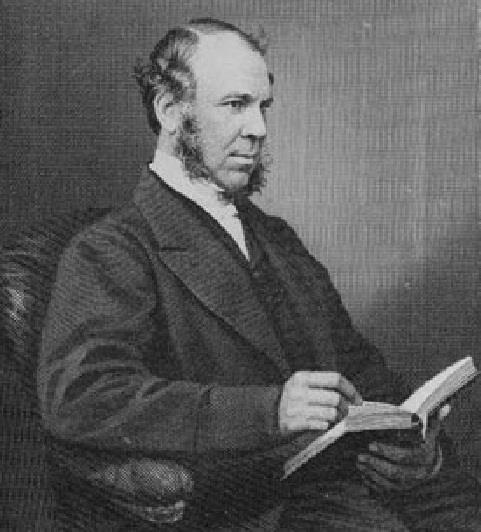
“Holiness is the habit of being of one mind with God, according as we find His mind described in Scripture. It is the habit of agreeing in God’s judgment, hating what He hates, loving what He loves, and measuring everything in this world by the standard of His Word. We must be holy, because this is the only sound evidence that we have a saving faith in our Lord Jesus Christ.”
– J.C. Ryle
What is Apostasy? – A.W. Pink (Audio reading with text)
A.W. Pink Playlist: http://www.youtube.com/view_play_list?p=10C95ED824AA4503
From Studies in the Scriptures.
2 Corinthians 13:5 Test yourselves to see if you are in the faith; examine yourselves! Or do you not recognize this about yourselves, that Jesus Christ is in you—unless indeed you fail the test?
1 John 5:4 For whatever is born of God overcomes the world; and this is the victory that has overcome the world—our faith.
Romans 6:14 For sin shall not be master over you, for you are not under law but under grace.
John 8:39 They answered and said to Him, “Abraham is our father.” Jesus said to them, “If you are Abraham’s children, do the deeds of Abraham.
1 Timothy 1:19 keeping faith and a good conscience, which some have rejected and suffered shipwreck in regard to their faith.
2 Peter 2:20 For if, after they have escaped the defilements of the world by the knowledge of the Lord and Savior Jesus Christ, they are again entangled in them and are overcome, the last state has become worse for them than the first.
Luke 9:62 But Jesus said to him, “No one, after putting his hand to the plow and looking back, is fit for the kingdom of God.”
Hebrews 10:38 BUT MY RIGHTEOUS ONE SHALL LIVE BY FAITH;
AND IF HE SHRINKS BACK, MY SOUL HAS NO PLEASURE IN HIM.
John 6:66 As a result of this many of His disciples withdrew and were not walking with Him anymore.
Isaiah 28:13 So the word of the LORD to them will be,
“Order on order, order on order,
Line on line, line on line,
A little here, a little there,”
That they may go and stumble backward, be broken, snared and taken captive.
A.W. Pink (1886-1952): Pastor, itinerate Bible teacher, author of Studies in the Scriptures and many books including his well-known The
Sovereignty of God; born in Great Britain, immigrated to the U.S., and later returned to his homeland in 1934; born in Nottingham, England.


