“An essential ingredient or element in saving faith is a yielding to the authority of God, a submitting of myself to His rule. To be received by Christ I must not only come to Him renouncing all my own righteousness (Romans 10:3), as an empty-handed beggar, but I must also forsake my self-will and rebellion against Him. In coming to Christ something has to be left.”
John 9:39 And Jesus said, For judgment I am come into this world, that they which see not might see; and that they which see might be made blind. 40 And some of the Pharisees which were with him heard these words, and said unto him, Are we blind also? 41 Jesus said unto them, If ye were blind, ye should have no sin: but now ye say, We see; therefore your sin remaineth.
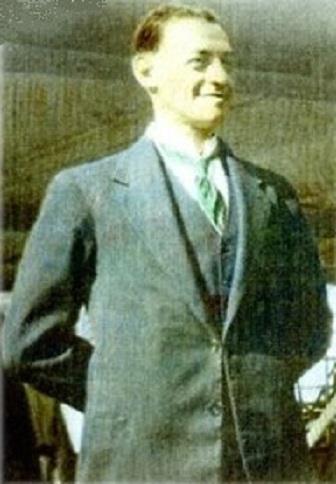
Arthur Walkington Pink (1886-1952) evangelist and Biblical scholar
Pink was born in Nottingham, England on April 1, 1886 and became a Christian in his early 20’s. Though born to Christian parents, prior to conversion he migrated into a Theosophical society (an occult gnostic group popular in England during that time), and quickly rose in prominence within their ranks. His conversion came from his father’s patient admonitions from Scripture. It was the verse, Proverbs 14:12, ‘there is a way which seems right to a man, but its end is the way of death,’ which particularly struck his heart and compelled him to renounce Theosophy and follow Jesus.
Desiring to grow in knowledge of the Bible, Pink immigrated to the United States to study at Moody Bible Institute. In 1916 he married Vera E. Russell, who was from Kentucky. However, he left after just two months for Colorado, then California, then Britain. From 1925 to 1928 he served in Australia, including as pastor of two congregations from 1926 to 1928, when he returned to England, and to the United States the following year. He eventually pastored churches Colorado, California, Kentucky and South Carolina.
In 1922 he started a monthly magazine entitled Studies in Scriptures which circulated among English-speaking Christians worldwide, though only to a relatively small circulation list of around 1,000.
In 1934 Pink returned to England, and within a few years turned his Christian service to writing books and pamphlets. Pink died in Stornoway, Scotland on July 15, 1952. The cause of death was anemia.
After Pink’s death, his works were republished by the Banner of Truth Trust and reached a much wider audience as a result. Biographer Iain Murray observes of Pink, “the widespread circulation of his writings after his death made him one of the most influential evangelical authors in the second half of the twentieth century.” His writing sparked a revival of expository preaching and focused readers’ hearts on biblical living.
“Perhaps if there were more of that intense distress for souls that leads to tears, we should more frequently see the results we desire. Sometimes it may be that while we are complaining of the hardness of the hearts of those we are seeking to benefit, the hardness of our own hearts and our feeble apprehension of the solemn reality of eternal things may be the true cause of our want of success.”
Charles’ main characteristic said Edward Morgan (his editor), was his large measure of love and humility. His life itself, ‘with heaven in his face’, as men said was a sermon.
For insight into real, biblical Christianity this book will always be one of the classics of evangelical literature. John Elias’ verdict of many years ago remains true, ‘Whatever proceeds from Mr Charles is excellent’. This was one of the last books in the hands of Dr Martyn Lloyd-Jones before his death and it led him to conclude that Thomas Charles ‘is definitely one of the most neglected of the spiritual leaders’.
Ephesians 6:10 Finally, my brethren, be strong in the Lord and in the power of His might. 11 Put on the whole armor of God, that you may be able to stand against the wiles of the devil. 12 For we do not wrestle against flesh and blood, but against principalities, against powers, against the rulers of the darkness of this age, against spiritual hosts of wickedness in the heavenly places. 13 Therefore take up the whole armor of God, that you may be able to withstand in the evil day, and having done all, to stand. 14 Stand therefore, having girded your waist with truth, having put on the breastplate of righteousness, 15 and having shod your feet with the preparation of the gospel of peace; 16 above all, taking the shield of faith with which you will be able to quench all the fiery darts of the wicked one. 17 And take the helmet of salvation, and the sword of the Spirit, which is the word of God; 18 praying always with all prayer and supplication in the Spirit, being watchful to this end with all perseverance and supplication for all the saints
Arthur Walkington Pink (1886-1952) evangelist and Biblical scholar
Pink was born in Nottingham, England on April 1, 1886 and became a Christian in his early 20’s. Though born to Christian parents, prior to conversion he migrated into a Theosophical society (an occult gnostic group popular in England during that time), and quickly rose in prominence within their ranks. His conversion came from his father’s patient admonitions from Scripture. It was the verse, Proverbs 14:12, ‘there is a way which seems right to a man, but its end is the way of death,’ which particularly struck his heart and compelled him to renounce Theosophy and follow Jesus.
Desiring to grow in knowledge of the Bible, Pink immigrated to the United States to study at Moody Bible Institute. In 1916 he married Vera E. Russell, who was from Kentucky. However, he left after just two months for Colorado, then California, then Britain. From 1925 to 1928 he served in Australia, including as pastor of two congregations from 1926 to 1928, when he returned to England, and to the United States the following year. He eventually pastored churches Colorado, California, Kentucky and South Carolina.
In 1922 he started a monthly magazine entitled Studies in Scriptures which circulated among English-speaking Christians worldwide, though only to a relatively small circulation list of around 1,000.
In 1934 Pink returned to England, and within a few years turned his Christian service to writing books and pamphlets. Pink died in Stornoway, Scotland on July 15, 1952. The cause of death was anemia.
After Pink’s death, his works were republished by the Banner of Truth Trust and reached a much wider audience as a result. Biographer Iain Murray observes of Pink, “the widespread circulation of his writings after his death made him one of the most influential evangelical authors in the second half of the twentieth century.” His writing sparked a revival of expository preaching and focused readers’ hearts on biblical living.
Arthur Walkington Pink (1886-1952) evangelist and Biblical scholar
Pink was born in Nottingham, England on April 1, 1886 and became a Christian in his early 20’s. Though born to Christian parents, prior to conversion he migrated into a Theosophical society (an occult gnostic group popular in England during that time), and quickly rose in prominence within their ranks. His conversion came from his father’s patient admonitions from Scripture. It was the verse, Proverbs 14:12, ‘there is a way which seems right to a man, but its end is the way of death,’ which particularly struck his heart and compelled him to renounce Theosophy and follow Jesus.
Desiring to grow in knowledge of the Bible, Pink immigrated to the United States to study at Moody Bible Institute. In 1916 he married Vera E. Russell, who was from Kentucky. However, he left after just two months for Colorado, then California, then Britain. From 1925 to 1928 he served in Australia, including as pastor of two congregations from 1926 to 1928, when he returned to England, and to the United States the following year. He eventually pastored churches Colorado, California, Kentucky and South Carolina.
In 1922 he started a monthly magazine entitled Studies in Scriptures which circulated among English-speaking Christians worldwide, though only to a relatively small circulation list of around 1,000.
In 1934 Pink returned to England, and within a few years turned his Christian service to writing books and pamphlets. Pink died in Stornoway, Scotland on July 15, 1952. The cause of death was anemia.
After Pink’s death, his works were republished by the Banner of Truth Trust and reached a much wider audience as a result. Biographer Iain Murray observes of Pink, “the widespread circulation of his writings after his death made him one of the most influential evangelical authors in the second half of the twentieth century.” His writing sparked a revival of expository preaching and focused readers’ hearts on biblical living.
A.W. Pink – Internal Salvation
Philippians 1:6
King James Version (KJV)
6Being confident of this very thing, that he which hath begun a good work in you will perform it until the day of Jesus Christ:
Philippians 3:13 Brothers and sisters, I do not consider myself yet to have taken hold of it. But one thing I do: Forgetting what is behind and straining toward what is ahead, 14 I press on toward the goal to win the prize for which God has called me heavenward in Christ Jesus.
Colossians 1:29 To this end I strenuously contend with all the energy Christ so powerfully works in me.
James Russell Miller was born on March 20, 1840 at Frankfort Springs, Pennsylvania and died on July 2, 1912. Besides authoring over 80 books, booklets, and pamphlets, he was the Editorial Superintendent of the Presbyterian Board of Publication and a very active pastor in a succession of churches.
The crucible of his education was his service with the United States Christian Commission, an agency set up to minister to the troops, during the civil war. When the war ended he completed his theological studies and was ordained and installed on September 11, 1867. On June 22, 1870, when he was thirty, he married Miss Louise E. King.
The end of life on earth came without warning on the afternoon of July 2, 1912. JR’s wife, Louise Miller, and their only daughter, Mary Wanamaker Miller (Mrs. W.B. Mount), were present, but it was impossible to summon the sons — William King Miller and Russell King Miller. One moment he seemed to be resting quietly; the next he was at rest.
He was one of the best selling Christian authors of his era. His books had a total circulation of over two million copies during his lifetime and in 1911 the Presbyterian Board of Publication, under his direction, published over 66 million copies of its periodicals.