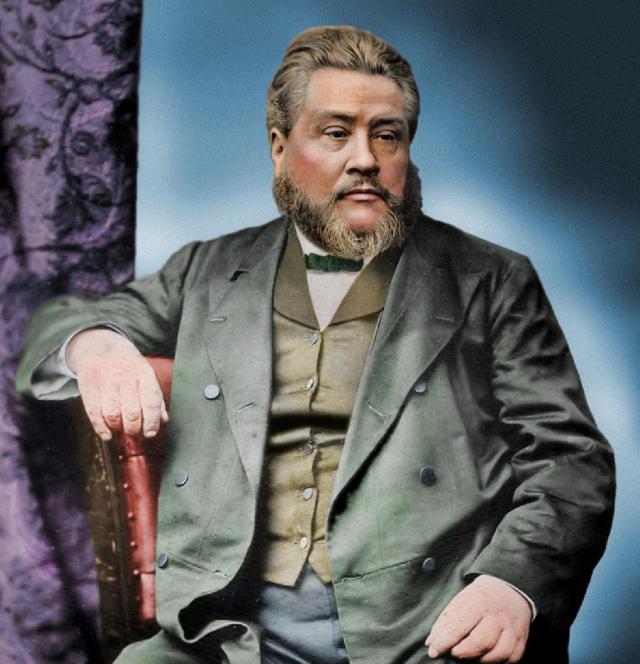
Joseph Charles Philpot (1802 — 1869) was known as “The Seceder”. He resigned from the Church of England in 1835 and became a Strict & Particular Baptist. While with the Church of England he was a Fellow of Worchester College, Oxford. After becoming a Strict and Particular Baptist he became the Editor of the Gospel Standard magazine and served in that capacity for twenty years.
Educated at Oxford University, he was elected a fellow of Worcester College, and appeared to have a brilliant scholastic career before him. But he was brought into solemn concern spiritually and the Lord led him into the ministry. He first preached in the Established Church at Stadhampton (Oxfordshire). In 1835, however, he was constrained, for the truth’s sake, to sever his connection with the Church of England and to resign his curacy and his fellowship. The letter to the provost stating his reasons was published and went into several editions.
The same year, he was baptized by John Warburton at Allington (Wilts). The rest of his life was spent ministering among the Strict Baptists. For 26 years, he held a joint pastorate at Stamford (Lines) and Oakham (Rutland). In addition for over twenty years, he was editor of “The Gospel Standard”, where many of his sermons first appeared. “My desire is to exalt the grace of God; to proclaim salvation alone through Jesus Christ; to declare the sinfulness, helplessness and hopelessness of man in a state of nature; to describe the living experience of the children of God in their trials, temptations, sorrows, consolations and blessings.” – J.C. Philpot
“We know others to whom the end-all and be-all of religion is an orthodox statement of doctrine. So long as the preaching is according to the confession of faith, and every word and act is piously correct, they are well pleased; but no love to Jesus ever stirs their bosoms, religion to them is not an exercise of the heart at all — it is mere brain work, and hardly that. They know nothing of the living soul going out towards a living person, a bleeding heart knit to another bleeding heart, a life subsisting on another life and enamoured of it.
“We know brethren who carry this very far, and if the preacher differs from them in the merest shade, they are overwhelmed with pious horror at his unsoundness, and they cannot hear him again: even if he preach Christ most preciously in all the rest of his discourse, it is nothing, because he cannot sound their ‘Shibboleth.'”
– Charles Haddon The Daily Spurgeon
shib·bo·leth [shib-uh-lith, ‐leth]
1.a peculiarity of pronunciation, behavior, mode of dress, etc., that distinguishes a particular class or set of persons.
2.a slogan; catchword.
3.a common saying or belief with little current meaning or truth.
Origin: Hebrew shibbōleth literally, freshet, a word used by the Gileadites as a test to detect the fleeing Ephraimites, who could not pronounce the sound sh (Judges 12:4–6)
Sins and Surroundings of the Soul
Psalm 6 refers to the surroundings of the soul in bodily sickness and perplexity and the inward results of these. The Psalmist’s first degree of prayer is, ”Heal me; for my bones are vexed”; the second degree is, Heal me, ”for my soul is also sore vexed,” and the third degree is, ”Save me for Thy mercies’ sake.” These are three degrees of perplexity arising from the soul’s surroundings: because of pain; because the mental outlook is cloudy, and because God has not said a word. When the soul is perplexed—and it certainly will be if we are going on with God, because we are a mark for Satan—and the sudden onslaught comes, as it did in the life of Job, we cry, “Heal me because of my pain,” but there is no answer. Then we cry, “Heal me, not because I am in pain, but because my soul is perplexed; I cannot see any way out of it or why this thing should be”; still no answer; then at last we cry, “Heal me, O Lord, not because of my pain, nor because my soul is sick, but for Thy mercies’ sake.” Then we have the answer, ”The Lord hath heard my supplication.” The surroundings of the soul, the scenes which arise from our doings, do produce perplexity in the soul. The soul cannot be separated from the body, and bodily perplexities produce difficulties in the soul, and these difficulties go inward and at times intrude right to the very throne of God in the heart.
“Behold, all souls are Mine; . . . the soul that sinneth, it shall die” (Ezekiel 18:4). In this passage the soul life and the sin that is punished are connected. The inherited disposition of sin must be cleansed, but for every sin we commit we are punished. “Receiving the end of your faith, even the salvation of your souls” (1 Peter 1:9). “Salvation” refers to the whole gamut of a man, spirit, soul and body; ”Christ the firstfruits,” with the ultimate reach in the hereafter of our spirit, soul and body being like His in a totally new relationship. The soul in the present life can be satisfied in all its perplexities, and in all onslaughts and dangers it is kept by the power of God. Sin destroys the power of the soul to know its sin, punishment brings awakening, self-examination brings chastisement and saves the soul from sleeping sickness, and brings it into a healthy satisfaction.
In 1 Corinthians 11:30 (“For this cause many are weak and sickly among you, and many sleep”), Paul alludes to sickness which has a moral and not a physical source. The immediate connection is the obscene conduct at the Lord’s Supper of former heathen converts, and Paul says that that is the cause of their bodily sickness. The truth laid down abides, that certain types of moral disobedience produce sicknesses which physical remedies cannot touch; obedience is the only cure. For instance nothing can touch the sicknesses produced by tampering with spiritualism; there is only one cure—yielding to the Lord Jesus Christ.’
In this book, Andrew Murray explores the dynamics of the Christian life as Jesus means it to be lived. He explains how the Holy Spirit is essential to living effectively as a believer. Christians are often all too well aware of the feebleness of their life and testimony. This most encouraging book, consisting of a series of lectures given to students at the Moody Bible Institute in Chicago in 1895, shows how the working of the Holy Spirit in the Christian’s life makes all the difference. It shows how God’s power is made perfect in weakness, and how His Holy Spirit may animate and renew every area of the believer’s life. (Summary by Christopher Smith)
Andrew Murray – (1828-1917), South-African Dutch Reformed leader, author of devotional writings
Murray was Born in Cape Town, South Africa, Murray became a noted missionary leader. His father was a Scottish Presbyterian serving the Dutch Reformed Church of South Africa, and his mother had connections with both French Huguenots and German Lutherans. This background to some extent explains his ecumenical spirit. He was educated at Aberdeen University, Scotland, and at Utrecht University in the Netherlands. After ordination in 1848 he served pastorates at Bloemfontein, Worcester, Cape Town, and Wellington. He helped to found what are now the University College of the Orange Free State and the Stellenbosch Seminary He served as Moderator of the Cape Synod of the Dutch Reformed Church and was president of both the YMCA (1865) and the South Africa General Mission (1888-1917), now the Africa Evangelical Fellowship.
He was one of the chief promoters of the call to missions in South Africa. This led to the Dutch Reformed Church missions to blacks in the Transvaal and Malawi. Apart from his evangelistic tours in South Africa, he spoke at the Keswick and Northfield Conventions in 1895, making a great impression. upon his British and American audiences. For his contribution to world missions he was given an honorary doctorate by the universities of Aberdeen (1898) and Cape of Good Hope(1907).
Murray is best known today for his devotional writings, which place great emphasis on the need for a rich, personal devotional life. Many of his 240 publications explain in how he saw this devotion and its outworking in the life of the Christian. Several of his books have become devotional classics. Among these are Abide in Christ, Absolute Surrender, With Christ in the School of Prayer, The Spirit of Christ and Waiting on God.
“We have to form the mind of Christ until we are absorbed with Him and take no account of the evil done to us. No love on earth can do this but only the love of God.”
John 13:7 Jesus replied, “You do not realize now what I am doing, but later you will understand.”
James Russell Miller was born on March 20, 1840 at Frankfort Springs, Pennsylvania and died on July 2, 1912. Besides authoring over 80 books, booklets, and pamphlets, Dr. J.R. Miller was the Editorial Superintendent of the Presbyterian Board of Publication and a very active pastor in a succession of churches.
The crucible of J.R. Miller’s education was his service with the United States Christian Commission, an agency set up to minister to the troops, during the civil war. When the war ended Miller completed his theological studies and was ordained and installed on September 11, 1867. On June 22, 1870, when he was thirty, he married Miss Louise E. King.
The end of life on earth came without warning on the afternoon of July 2, 1912. JR’s wife, Louise Miller, and their only daughter, Mary Wanamaker Miller (Mrs. W.B. Mount), were present, but it was impossible to summon the sons — William King Miller and Russell King Miller. One moment Dr. Miller seemed to be resting quietly; the next he was at rest.
JR Miller DD was one of the best selling Christian authors of his era. Rev. Miller’s books had a total circulation of over two million copies during his lifetime and in 1911 the Presbyterian Board of Publication, under his direction, published over 66 million copies of its periodicals.
John Calvin – (1509-1564), French reformer and theologian
Born July 10, 1509 in Noyon, France, Jean Calvin was raised in a staunch Roman Catholic family. The local bishop employed Calvin’s father as an administrator in the town’s cathedral. The father, in turn, wanted John to become a priest. Because of close ties with the bishop and his noble family, John’s playmates and classmates in Noyon (and later in Paris) were aristocratic and culturally influential in his early life.
At the age of 14 Calvin went to Paris to study at the College de Marche in preparation for university study. His studies consisted of seven subjects: grammar, rhetoric, logic, arithmetic, geometry, astronomy, and music. Toward the end of 1523 Calvin transferred to the more famous College Montaigu. While in Paris he changed his name to its Latin form, Ioannis Calvinus, which in French became Jean Calvin. During this time, Calvin’s education was paid for in part by income from a couple of small parishes. So although the new theological teachings of individuals like Luther and Jacques Lefevre d’Etaples were spreading throughout Paris, Calvin was closely tied to the Roman Church. However, by 1527 Calvin had developed friendships with individuals who were reform-minded. These contacts set the stage for Calvin’s eventual switch to the Reformed faith. Also, at this time Calvin’s father advised him to study law rather than theology.
By 1528 Calvin moved to Orleans to study civil law. The following years found Calvin studying in various places and under various scholars, as he received a humanist education. By 1532 Calvin finished his law studies and also published his first book, a commentary on De Clementia by the Roman philosopher, Seneca. The following year Calvin fled Paris because of contacts with individuals who through lectures and writings opposed the Roman Catholic Church. It is thought that in 1533 Calvin experienced the sudden and unexpected conversion that he writes about in his foreword to his commentary on the Psalms.
For the next three years, Calvin lived in various places outside of France under various names. He studied on his own, preached, and began work on his first edition of the Institutes of the Christian Religion, an instant best seller. By 1536 Calvin had disengaged himself from the Roman Catholic Church and made plans to permanently leave France and go to Strasbourg. However, war had broken out between Francis I and Charles V, so Calvin decided to make a one-night detour to Geneva.
But Calvin’s fame in Geneva preceded him. Farel, a local reformer, invited him to stay in Geneva and threatened him with God’s anger if he did not. Thus began a long, difficult, yet ultimately fruitful relationship with that city. He began as a lecturer and preacher, but by 1538 was asked to leave because of theological conflicts. He went to Strasbourg until 1541. His stay there as a pastor to French refugees was so peaceful and happy that when in 1541 the Council of Geneva requested that he return to Geneva, he was emotionally torn. He wanted to stay in Strasbourg but felt a responsibility to return to Geneva. He did so and remained in Geneva until his death May 27, 1564. Those years were filled with lecturing, preaching, and the writing of commentaries, treatises, and various editions of the Institutes of the Christian Religion.
Carl R. Trueman, Professor of Historical Theology and Church History and
Paul Woolley Chair of Church History at Westminster Theological Seminary.
Education MA, St. Catharine’s College, Cambridge, 1988 PhD, University of Aberdeen, 1991
Teaching Tutorial Assistant in Church History, University of Aberdeen, 1991–1993 Lecturer in Theology, University of Nottingham, 1993–1998 Senior Lecturer in Church History, University of Aberdeen, 1998–2001 Westminster, 2001–
“Whoever humbles himself like this child is the
greatest in the kingdom of heaven.” Matt. 18:4
“All of you, clothe yourselves with humility toward
one another, because God opposes the proud but
gives grace to the humble.” 1 Peter 5:5
Thomas Brooks (1608-1680), Nonconformist Puritan preacher and author.
Thomas Brooks was born in 1608. He entered Emmanuel College, Cambridge, in 1625, where such New England Puritans as Thomas Hooker, John Cotton, and Thomas Shepard were also educated, but he appears to have left before graduating. Brooks was ordained as a preacher of the gospel in 1640 and became a chaplain to the parliamentary fleet, serving for some years at sea. That ministry is mentioned in some of his “sea-devotions” as well as his statement: “I have been some years at sea and through grace I can say that I would not exchange my sea experiences for England’s riches.”
After the Civil War, Brooks became minister at the church of St. Thomas the Apostle, Queen Street, London (1648-1651). He was often called to preach before Parliament. In 1652, he became rector of St. Margaret’s, New Fish Street Hill, which was the first church that burned to the ground in the Great Fire of London (1666). Like Thomas Goodwin and John Owen, Brooks preferred the Congregational view of church government. In 1662, he fell victim to the notorious Act of Uniformity.
After being ejected from his living, Brooks continued to preach in London, where he apparently suffered little persecution. He became minister of a congregation at Moorfields, near St. Margaret’s. Unlike many ministers, he stayed in London during the Great Plague of 1665, faithfully tending his flock. In 1672, he was licensed to preach according to the terms of the Declaration of Indulgence, but that license was revoked in 1676.
Brooks lost his first wife, Martha Burgess, a godly woman whom he greatly treasured, in 1676. He wrote of her, “She was always best when she was most with God in a corner. She has many a whole day been pouring out her soul before God for the nation, for Zion, and the great concerns of her own soul.” He later married a young God-fearing woman named Patience Cartwright (Alexander Grosart puts it succinctly: “she spring-young, he winter-old” [Works of Brooks, 1:xxxv]), who proved a most worthy companion.
Brooks died in 1680 and was buried in Bunhill Fields, London’s famous nonconformist cemetery. John Reeve, who preached at the funeral, said Brooks had “a sweet nature, great gravity, large charity, wonderful patience, and strong faith.”
Christian Worship Praise Songs Lyrics 2013 – Behold, I am Coming Quickly! / Revelation 3
I am a singer, guitarist, and songwriter. This is a new original contemporary Christian song I recently wrote and recorded. May those who listen find it a great blessing, to the glory of the Lord Jesus Christ, in these last days. (Music and video owned and copyrighted by stack45ny)
Revelation 3:10 Because you have kept My command to persevere, I also will keep you from the hour of trial which shall come upon the whole world, to test those who dwell on the earth. 11 Behold, I am coming quickly! Hold fast what you have, that no one may take your crown. 12 He who overcomes, I will make him a pillar in the temple of My God, and he shall go out no more. I will write on him the name of My God and the name of the city of My God, the New Jerusalem, which comes down out of heaven from My God. And I will write on him My new name.
13 “He who has an ear, let him hear what the Spirit says to the churches.”‘
Isaiah 41:10 Fear not, for I am with you; Be not dismayed, for I am your God. I will strengthen you, Yes, I will help you, I will uphold you with My righteous right hand.’
When you miss the centrality of God’s Kingly Freedom in glorifying Himself the rest of the biblical revelation will become muddled and self-contradictory. Here’s an example.